Showing posts with label articulation. Show all posts

Friday, 6 September 2013

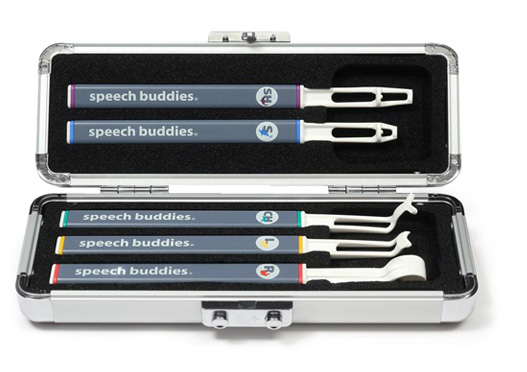
Speech Buddies


Its been quite sometime since I first read about the advent of speech buddies. I was so thrilled to learn about such amazing advancements in the speech therapy world!
Speech Buddies are a set of revolutionary tools that help in correcting specific articulation                               ( pronunciation) errors. Specifically made for the 5 most common erroneous speech sounds - R, L, S, CH, SH.
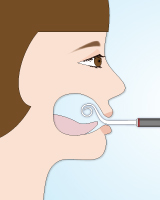
They work on the principle of tactile biofeedback.They help users to learn where exactly to place the tongue inside the mouth to produce the specific speech sounds.Each speech buddy uses targets to help tongue placement and coordination. There is tons of researched data highlighting the success stories of speech buddies in the western countries.


Speech Buddies can quickly help children turn their Wabbits into Rabbits, Wessons into Lessons, and Thocks into Socks!

Parents can choose to use Speech Buddies at home with their child or bring their Buddy to speech therapy lessons with the goal of accelerating learning and correcting problem sounds.

Visit www.speechbuddy.com for more information.


I have ordered my set of speech buddies and I cant wait to use it with my clients :)

Thursday, 15 March 2012

Tongue Aerobics


Tongue is one of the busiest muscles in a Speech Therapist's body :) 
Talking, Tasting, Swallowing, Chewing, Singing ...all are possible because of this dynamic muscular oral organ.

I do a lot of 'tongue aerobics' with kids who need to exercise their tongues to elicit clearer speech. Here is an insight -


Home based activities to develop tongue protrusion (Sticking the tongue out)
  • Push or show how to push your child's tongue against an object like - a flat spoon, tongue depressor, an ice cream stick, cheerios on the plate etc.
  • Ask your child to balance a cheerio/crax/small fried onion ring/ a piece of chocos cereal ( anything small and light) on the tip of her tongue.
  • Play an imitation game of poking the tongue out like a snake. Sit in front of the mirror and encourage your child to copy you.
  • Encourage your child to lick foods from a plate. Get all messy with stuff like ketchup/chocolate syrup/honey/ sweetened malai/ kheer/ yoghurt etc. Your child should use her tongue and not the lips..
  • Encourage licking of stuff mentioned above from a spoon.Use colorful spoons to draw your child's attention to the activity.
  • Encourage your child to lick ice creams - sundaes/softies/choco bar etc
  • Place food stuff ( mentioned above) on the lips and ask your child to lick them. Get innovative with your little one's favourite sticky foods and use them in this game which works best while played in front of a mirror.. Mom does it, and then the baby does it..
Tongue Retraction ( Pulling the tongue in)
  • Use difficult to blow whistles/party horns etc
  • Encourage longer and sustained blowing -- like blowing bubbles
  • Drinking with different sized straws. Use thinner liquids first and then move on to thicker shakes and smoothies. The Krushers at KFC is ideal for thick shake sucking. I even like their fat straw :)
Tongue Lateralization ( Moving the tongue from side to side)
  • Licking sticky foods from the corner of the mouth.
  • Put small bits of melt in the mouth foods like - chocolate buttons/ crackers/orange candies etc
  • Show your little one how to chew with molars ( back teeth). Use crunchy foods like carrot sticks/ onion/raddish salad/sprouts/soup sticks etc
Tongue Tip elevations ( Lifting the tongue)
  • Get your child to lick from a plate wth sticky food placed in front of the face.
  • Dab a long line of chocolate sauce on the lip line and encourage your child to lick it all at one go with his tongue tip.
  • Tongue Lifts - Think youre a weight lifter and youre lifting cheerios with your tongue..how many can you lift and how fast??
  • Open your mouth a little, then slowly lick around your lips in a circle, clockwise and then anticlockwise. Ask your child to imitate
  • Open your mouth a lot and repeat the aforesaid.
  • Try touching the nose with your tongue tip.
  • Try touching the chin with your tongue tip
  • Do the nose and chin touch consecutively. Do this 3 times.
  • Poke your tongue into your left cheek and then into the right cheek.. Repeat 5-6 times.
  • Clean your teeth with your tongue
  • Make faces in the mirror. Ask your child to copy you :) Children love this !
Practical Ideas to develop better tongue movements from a mother's point of view :)
  • When spoon-feeding your child, place  the food centrally on the  tongue and apply firm  downward  pressure. This will reduce tongue  protrusion that occurs during swallowing.
  • As the protrusion reduces, place the food at the sides of the mouth, between the teeth. This will encourage munching and sidewards tongue movements. 
  • To stimulate biting, munching and sidewards tongue movements.
    •  Initially, do this at times when your child is relaxed.
    • Initially, these activities should not be done at mealtimes. 
    • Use items such as teethers (ridged etc.), foods that do not break up (bite & stay firm  foods - Dried fruit: bananas / peaches / apricots etc
    • Place the item in the mouth, between the teeth, along the line of the jaw and  ensure that  it  is not placed  so  as to  stretch the lips.  Do  not  place too far back in case your child gags.
    • Place on the best side initially, than move to the other side.
    • If the child is not munching, pull the item out slightly and gently or press down.
    • When you feel your child is confident about  their biting  skills, introduce food items. Initially use bite-and-dissolve foods  (Glucose biscuits,Crax, etc.). 
    • If the child is not biting off the food, break it off for them while they are biting down on it. Do not force your child to take foods that their mouth is not ready to handle.
    • Over time, gradually introduce chewier foods in the same way.

Wednesday, 8 February 2012

The nosy N sound

/n/ speech sound is produced when the air comes out from the mouth as well as the nose. Typically achieved by the age of 3-4 years. Here are some practice words.


Get your /ch/ & /dge/ right

/ch/ & /dge/ sounds are tough ones to master and are typically achieved by your child's 6th-7th birthday.

-- Here are the word lists --


Practice F & V

The speech sound F is mastered by the age of 4 years while V is achieved by 6-7 years.
Here are the relevant word lists that you can print and use with your little one.


The Noisy sounds - /s/ & /sh/

These noisy /s/ and /sh/ speech sounds are misarticulated (mis pronounced) the most by children.

Rule out - 
  • Hearing loss
  • Tongue thrust
  • Linguistic or regional bias
Like other speech sounds, these are also taught in isolation through Imitation and Phonetic placement techniques and later words are practiced. 
Here are some practice pictures and words.


Bilabial Speech sounds - /b/, /p/, /m/

Bilabial sounds ( those produced with both lips) are normally the 1st ones to be mastered by your child. 
( Age of mastery = 3 years).
To give your toddler more practice , you can use the following pictures.


Errors in pronouncing /k/ & /g/ ??

You need to raise an alarm if the /k/ or /g/ speech sounds are not mastered by your child till her 4th/5th birthday.

Articulation (Pronunciation) errors of the /k/ and /g/ speech sounds are quite commonly seen in toddlers. Mostly /k/ sound is misarticulated as /t/. Also /g/ becomes /d/. For example, "This is a cow" becomes "This is a tow"... and " The goat ate green grass" becomes "The doat ate dreen drass".

Like all other sounds, I 1st teach /k/ & /g/ sounds in isolation and then move on to the word level. Feel free to copy and print the pictures below to teach generalization of /k/ & /g/ speech sounds.


Sunday, 5 February 2012

"Bag mein kya hai?" (What's in the bag?) - A language game

If you have seen any of my sessions you would be familiar with this game. I employ this simple activity to work upon skills of- instruction following,comprehension, identification, differentiation, naming of different objects, along with language stimulation & expansion and turn takng.


What do I do?
I take a small attractive/colourful bag , fill it with the objects of target words ( e.g transport vehicles or animals or daily objects etc). I swing the bag in front of the child while singing.."bag mein kya hai..." ( you can cook up your own tune) and ask the child to take out any 1 object. Then we talk about the target object/toy in hand..sing related rhymes and keep it away to move on to the next object.I switch turns and reward on each good attempt by the child.This activity works superbly in one on one or group sessions too. 
I also use it as an articulation game sometimes when I place small articulation cards of the sounds Im working on.
Tip - Choose a translucent bag, so that your child cant see its contents right away.Hence the mystery quotient is maintained..


You must give this game a try and I'm sure your little one will love it :)


Can your child not say Rrrrrrrr?

Does your child say woti for roti or wose for rose? If your child is more than 7 years old and your answer is yes then she might be exhibiting an articulation(pronunciation) difficulty.
Typically the /r/ speech sound is achieved by the age of 7 years and its also the toughest sound to master. It requires very fine, quick & repetitive movements of the tongue against the palate, a skill which is learnt gradually.
Ironically, the /r/ sound is the most frequently occurring speech sound in English.
To correct the error , 1st the sound is taught in isolation and then later in words. Here are some common words with /r/ in the initial and final positions.


Consult a Speech Pathologist if your child shows the /r/ errors consistently!